Monday, March 11, 2013

Hotter than the 4th of July


Hotter than the 4th of July-Ghana Independence Day 2013


By Debi:


We all love the 4th of July but in Ghana they all love the 6th of March.  This is the date that Ghana received their independence from England.  It is a very important holiday for Ghana.  Just like the 4th of July in the United States, this holiday is always celebrated on the exact date of March 6th. 


The Church Office Building was closed for the holiday so Greg and I decided on our morning walk that we would walk to the Black Star Square (or Independence Square) to see what was happening.  To our amazement we experienced one of the most interesting events that we have seen since here in Africa.


All of the branches of the Military were represented in their full dress uniforms.  School children from various schools were there in their school uniforms ready to march for the President of Ghana. 


Greg and I always love a good parade.  The parade was to begin at 8:00 am so we decided to stay and watch.  First all of the soldiers marched into the square.  As they marched they would swing their arm up to shoulder height and the other arm held a gun.  There were several units with just women.  They were very sharp in their uniforms and held their guns with authority.  To contrast the day we took pictures of Muslim women walking in the crowds.


Here is a video we took of the march.  It is a bit shaky, sorry for that.  At the ended the people with the white long sleeved shirts are the students.  They were amazing.  We enjoyed watching them turn the corners.  The band played the entire time, but the sound you hear is what was going on around us.  We hope this comes through for you.


To lead the parade the military marching band came first onto the square.  They were a full band and played with strength.  The band played and marched for almost 3 hours.  That in and of itself was amazing but they were also a very good band.  Their drum majors were very colorful and full of energy.  They had 4 drum majors and every so often we would see their batons thrown into the air very high, spinning as they flew, and back into the drum major’s hands. 


When all of the military branches and school children where in their places, out in the square, a tribal chief came into view.  A full entourage followed him with the huge umbrella and body guards that you would expect to see in days gone by.


While we were waiting for the President to arrive in the square Greg and I noticed a first aid station on the edge of the square.  They had big shades and blankets rolled out on the ground.  I mentioned to Greg that I wondered what they were for.  Well it didn’t take to long for us to find out.  People standing at attention out in the hot sun on asphalt with hot uniforms are a formula for disaster.  After the first 45 minutes of the parade, people started to drop.  I thought it would only be the young students but even the soldiers started to go.  All of a sudden I saw a soldier just fall over.  The first aid people ran out as fast as they could and put him or her on a stretcher and run back to the first aid station putting them on the blanket on the ground.  They gave them water and let them rest.  Pretty soon some of the students started to pass out.  At first it was kind of interesting to watch all of the action but pretty soon my mother instincts kicked in and I started to worry about the children.  I couldn’t believe they were going to stand out there as long as the adult soldiers.  But after all of the full events of the morning of 3 hours the students did stand as long as the trained soldiers.


The stadium was packed with cheering citizens of Ghana. They love their country and they are proud of what they have been able to accomplish since they achieved their independence.  The one thing that I am so impressed with the people here in Ghana is their patriotism and their desire for peace and unity.  They love their country, their heritage, and they love God without any shame!  We all can take a lesson from the people of Ghana.


By Greg:


We had a tragedy this week that really shook us up.  The roads here are so narrow and they all have cement drain ditches (about 1-2 feet deep) along each side.  Thus there is no place for pedestrians to walk.  In fact, there is barely room for two vehicles to pass.  We were driving slowly and a car came toward us just as we passed a man walking toward us on our side of the street.  I thought I was OK but then there was a loud bang!  I looked and saw that our right mirror was knocked back into the closed position.  I realized then that we had hit the man with our mirror.  I stopped and looked back and I saw that he was hurt.


The man came up to Debi and was holding his arm and side.  He said he needed us to take him to the hospital.  We have been told to avoid that as we would then be responsible for his medical bills, his food, and the money he missed from work, his family and friends support and on and on.  I told him to take a taxi and gave him some money.  He said he needed money for the hospital.  I gave him 10 GHC for the taxi and 50 GHC for the hospital (about $30 USD).  His injuries were not life threatening and I am not sure it was my fault, but we were glad that he went away.  Except for the fact that he appeared to have a broken arm, we might have thought it was a sham.  They do that here.


When we got to the office we filed a report and took a few minutes to unwind.  This was a bit of a different experience that I do not want to repeat. One of my primary goals in my life is to get through this life without killing anyone.  I still am hoping to do this.


Now back to the parade.


We were amazed that all of the soldiers had guns. The women had gun.  The men had guns.  We were glad that the students did not, however.  I asked one of the soldiers if they had bullets.  He said, “Yes we have some.” They were so casual with these weapons of mass destruction (some people have said that the AK47 is the real WMD in the world).  Several times a gun would fall on the ground and the solider would just pick it up.  I fully expected it to start rattling off and killing all of us peace loving observers.


It is hard to have tight security when everyone has a weapon, but I guess that is the security.  Some of the older men had older weapons.  This man had a cool sword.


When the president came in he was escorted by a mounted guard.  These were on fine Arabian horses with banners.  Of course, the president was in a black car, as were all the other important people.  He came after the field was full of marchers and soldiers.


We were here at this arch about six months ago on Founder’s Day.  Behind the arched stadium stand is the ocean.  At the other end of the square is the Black Star Triumphal Arch.  All through the program General-looking men stood at attention and watched the activity.  They had a good view but I bet they were hot.  We did not see any of them drop.  We were on the stadium seating that lines both sides.  We had a canopy over us so we were not in the hot sun the entire time.


I think Ghana lost more men to heat stroke this day than they did in the last war.


They brought out all their hardware as well. They had fire trucks, army vehicles, missile launchers, cannons, assault vehicles and police vehicles.


The President inspected the troops.  He had these two really cool vehicles.  At first they looked like regular SUVs.  Then, of a sudden, the back opened up and the top retracted and steps appeared and he and his generals and his security detail walked up the steps and stood in the back of the vehicles as they went up and down the rows of soldiers and students.  As he came to the end he would wave at the crowd.  He is very popular.  I think he waved at Debi!  She did stand out it the crowd.


He also lit the “eternal flame” that I had a hard time getting a good picture of because the fire truck was in the way.  So it looks like the flame is being put out by the firemen.  We smiled to each other that the eternal flame is supposed to burn all of the time, but they are having a gas shortage as we speak.  The entire country is out of natural gas.  There is no hot water on Temple Square because there is no gas for the boilers.  Perhaps it was all used on the eternal flame.


Like our parades and rodeos, there were lots of hawkers selling everything from boiled eggs, rice and fish, kabobs of stuff, and candy to drinks of all shorts (we did not see alcohol drinks however) and flags and toys.  It was a fun day.  We walked home afterwards and was it hot!


So we have one more thing to report.  Next week we will write of our recent missionary experiences lest anyone doubt that we are really missionaries.  In fact, our new friend whose name is Sunday, and is from Nigeria, was baptized today.  We will say more next week.


Monday, March 4, 2013

Togo and Benin Part 2


By Greg:


OK.  Here is the history lesson.  For the benefit of my grandchildren that are studying African History, here is the model.  Now this applies to almost every country, so you can just add the country’s name, and you will get an A on your report.


1.     Prior to 1500-many tribes warring against each other-narrow down to two or three dominated tribes


2.     About 1500 the Europeans begin to arrive-first the Portuguese, then the Dutch, Danes, and later the French, Germans and English


3.     The Europeans are trading for Gold, Ivory, Slaves, timber or other natural recourses

4.     The late 1800s-Africa is divided up into Colonies by the Europeans-Africans are held in a lower status-not slaves, but close to it

5.     After World War 1 all of Germany’s possession are given to either France or England


6.     After World War 2 African Colonies begin to seek independence-the major period of independence was in the 1960s


7.     Following a free election, the president is deposed or assassinated or overthrown by a coup and a dictator is installed-usually a military dictator-heavy involvement by the CIA and the KGB


8.     Several coups follow, and one or two civil wars occur before the people demand a free election

9.     In the last ten years a fragile peace is reached and the voice of the people is heard, hopefully


Togo and Benin fit this pattern.  The both have access to the ocean and an up-land portion.


Togo, formerly Togoland, had two parts.  Western Togoland was German until it was given to England.  When Ghana became a country, western Togo joined Ghana.  Eastern Togoland became Togo, and was and is French speaking.


The dictator ruled for 40 years and was followed by his son.  The son has been “elected”.  The Capital is Lome which has about 1 ½ million people.  The entire country has 7 million.  29% are Christians, 20% are Muslims, and the remaining 51% are local religions.


Benin is also a former French colony.  It was originally called the Slave Coast.  It also was known as Dahomey-or land of snakes, because it has lots of snakes, big snakes.


In 1991 Benin had the first successful transition from a dictator to a democracy in Africa.  There are 9 ½ million people in Benin.  27% are Catholics, 16% are other Christians, 24% are Muslims and 33% are local. The Pope visited Benin and they made quite the effort to clean up the country.  It is still relatively clean.  Maybe the new Pope can visit more of Africa in the future.


The people of Benin were warriors, and they have a strong tradition of warrior women.  They were called after the women of Greek fame; Amazon Women.  They still have a female military unit and a Camp for these Amazons.

We have found the African women to be pretty aggressive, but I understand these Amazon Women were at the top of their game! 


We had quite the experience getting across these two borders.  Togo is very strict.  Ghana did not seem to care that we were leaving but Togo was watching us every second. They are the perfect example of redundancy.  The same paper must be examined and stamped by multiple people in different buildings and offices.  Of course, each charges a fee.  Then we had to get out of Togo.  It is as hard to get out as it was to get in.  Then we had to gain entrance into Benin.  We even had to pay for parking while we visited the many stations.  There is a Nazi type gate that is painted black and white and is raised and lowered to let you pass if you pay the operator.


The wonderful thing was we got to do it all over again when we returned from Benin to Ghana. Ghana paid more attention when we came back. 


We travelled with our friend and translator, Folly.  Debi told you he was raised to be chief of his village.  He is the oldest of all the children from two wives.  I asked him why he could not be an Elder in our Church and the Chief of his village.  He said there were several conflicts.  The ceremonial clothing of a Chief is not compatible with our standards of modesty and clothing.  Second, the Chiefs smoke.  He does not.  Third, and this was the most important, it is the Chief’s responsibility to “manage” the gods for his people.  They believe in lots of gods and none of them are the true God, so that poses a problem.  And finally, the Chief belongs to the people, which make it hard to choose your own spouse and life and profession.


While we were driving we came upon this funeral.  It is a little hard to see, but there is a casket being carried.  The big bush looking things with horns on top are gods.  Folly said there are naked people inside them acting in behalf of the gods.  It was a major road block, sort of a mini-parade.


In the hotel there was this cool totem-type pole. All around and to the top is a big snake.  At the top a big bird is fighting the snake.  This is Benin, land of snakes.


Also, there was a statue of an Amazon Woman.  I had Debi stand next to her so I could have two warriors in one picture.  The statue is a nude, but they put clothes on her so I could take her picture (the Amazon, not Debi).


One more thing.  While in Togo I met several policemen.  The mission president in Benin asked us to take back several cases of missionary tracts that were in English instead of French.  So it looked like we had contraband in the back of our car.  We had to open the back and show the pamphlets.  Some of them wanted a fee for inspection. One set motioned me to pull over but in Ghana I have just ignored that and driven on.  Well in Togo, one has a motorcycle and he jumped on it and chased us down.  Fortunately we decided to turn around and go back and turn ourselves in so we were not charged with resisting arrest.


Yesterday as we were shopping we were approached by a man for money.  I tried a new approach, and it worked so well I am going to use it again.  I turned to him and said, “We are seeking contributions for our church, would you like to contribute?” He almost ran away from us!


 I don't feel like we adequately described the traffice in Benin.  This picture does not even protray what we drove in.  There were millions of motorcycles.  These are diesel motorcycle, mostly made in China.  Along with the trucks and cars they provided a major challenge to drive in. It reminded me of the Oklohoma land rush.  There is a scene in the movie Far and Away that is very similar.  It was really wild.


A final note.  As we travel we must use the local currency.  It is really a challenge to figure out what things cost.  The exchange rate in Benin was 450:1.  I exchanged $1,000 USD and received 450,000 CFA.  They are in big notes of 1,000, 5,000 and 10,000.  At the boarder there are men with “fists full of dollars” ready to exchange and defraud.


I know this all sounds so romantic.  Some of the other couples wish they could travel more.  But we are doing this out of duty.  We did stay in a luxury hotel, and that was nice, and safe.  But usually in nice places the beds have a mountain of pillows.  This was our room.  And the pillows were rock-hard!


Welcome to Africa!


By Debi:


Our journey to Benin was probably one of our most dramatic trips because we drove instead of flying and we went through two countries.  The experience really made an impression upon us.


Right before we crossed the Ghana border into Togo we passed a little community that specializes in pots.  We passed a lot of little displays by the road.  They were so beautiful.  I wished I could sneak a couple of them into my luggage to bring home to my yard.  There is some real artist here in Africa.


At the border crossing into Togo I waited in the car with our entire luggage while Greg and Folly went into the offices to do the paper work.  I was protecting our luggage. I am not sure how I was going to do that but we made it safely through. I took a few pictures of the area.  When Greg and Folly came back to the car I found out that I wasn’t supposed to take pictures at the border crossing.  So these are once in a life time opportunity to see a border crossing in Africa.


Not too far into Togo we saw women making salt to sell in the market.  They have ponds that they let the seawater evaporate and then they harvest the salt.


The Church has built a brand new building in Togo. It is the first Church-built building in the country.  They have 12 branches and a District.  They are hoping that it will be made into a Stake very soon and 12 wards.  The second picture is one of the rentals that they are currently using.


We took a picture of Folly and his brother and the Branch President now serving in one of the Branches.  They are very thankful for the new building.


We spent a lot of Saturday at the Benin Mission home and Mission offices. We posted some pictures of the interior last week but this is what the outside looks like.  They use scrapes of tile left over from construction to make the outdoor walk ways.  It looks very nice and uses the pieces that would have been thrown away.  This is a very good way to use all of the materials.


While at Church in Benin I saw this bush outside of the building.  Many times we see razor wire (a very serious barbed-wire) protecting buildings and homes. With this bush outside of doors and windows I don’t think there will be any problems. This is a bush you don’t want to tangle with.


The members in Benin and Togo are so very strong.  The Church is young but growing fast. President and Sister Weed are the first Mission Presidents of this brand new mission.  The work is moving forward.  The young missionaries are excited and working hard. We loved our time in these amazing two countries.


Tuesday, February 26, 2013

Togo and Benin-Part One


By Debi:


Bonjour!


They have this signs around to remind everyone
Greg and I have just spent the last four days in French speaking countries!  Even though I cannot speak French, I love to listen to it.  The French language is so romantic and beautiful. We visited Togo and Benin.  They are beautiful countries and the people were very kind to us. Even when we were stopped by the police to check our passports and driver’s licenses they were respectful and welcoming.


Greg and I are charged with the calling of training the Priesthood Brethren throughout all of the Africa West Area in auditing and taking care of the scared funds of the Church.  We have now been to every country that is in this Area.  With the new missions announced last weekend our area will open three new missions this July.  That means we will have more Assistant Area Auditors to train and more Priesthood leaders to train in Auditing and Finances. The Church is very mindful of how expensive it would be to expect us to pay for all of our own travel expenses.  We are so grateful that they reimburse us for our travel.


The scenery was beautiful and in some places breathtaking.  We crossed the mighty Volta River at the eastern side of Ghana.  This river is the main source of water and electrical power for much of the western area of Africa.  We also saw the great shipping area of Lome’, Togo.  We tried to take a picture of the ships out to sea waiting to come into port. There were hundreds of ships.  The shipping yards were huge.  Togo has a free port so many companies use this port.


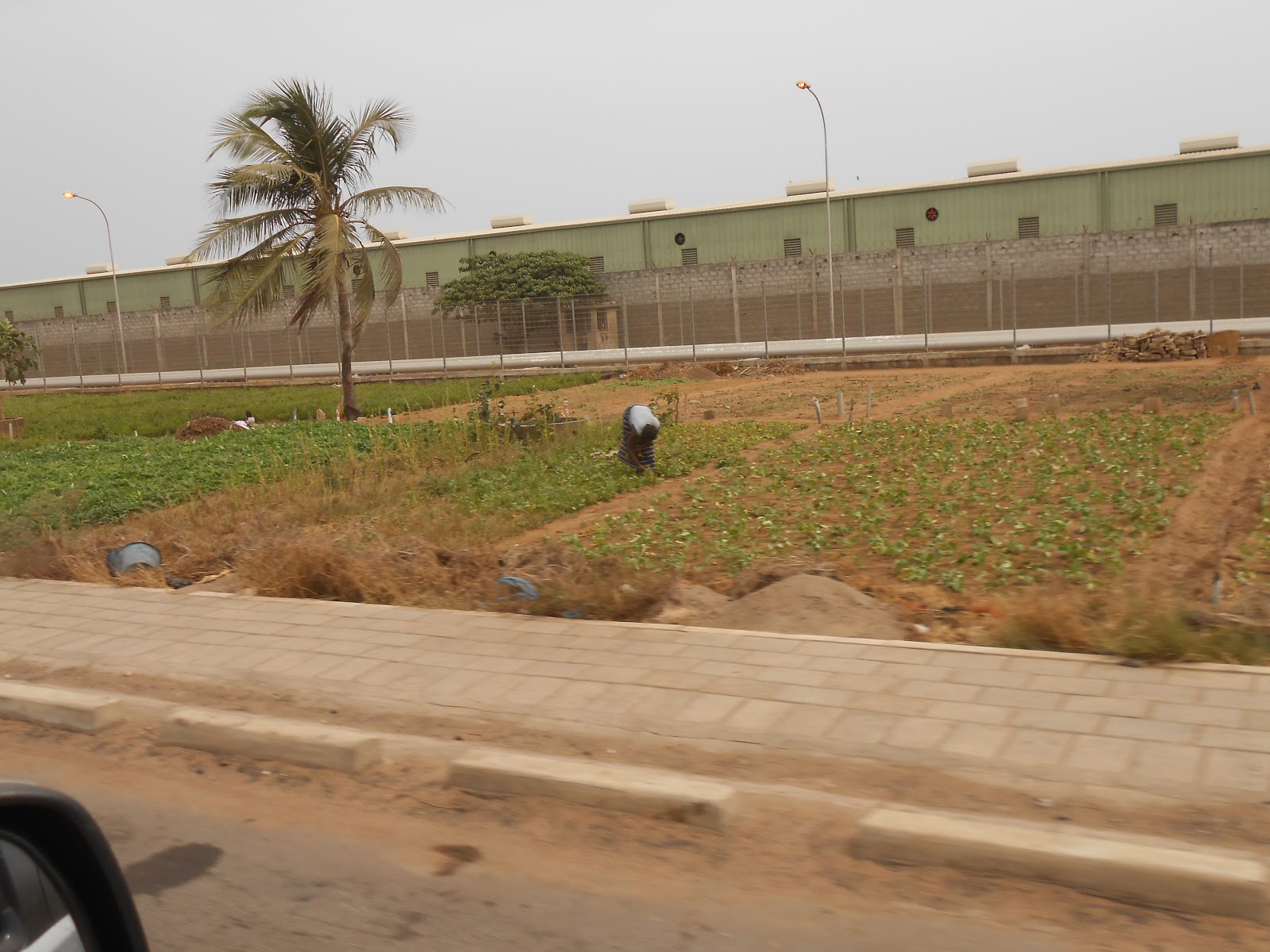
The people in Togo and Benin grow beautiful gardens. They use the land that is between the road and the warehouses and factories.  They keep such beautiful gardens and they water them all by hand.  We saw men with watering cans walking up and down the rows watering their plants.     


Also, while driving through Togo we saw a beautiful sight with a river flowing right into the sea. It is a beautiful area with white sand beaches and fresh water running into the salt water.


As we were driving through Benin we passed a beautiful lake.  Out in the middle of the lake some people have built a community on stilts. They actual live on the lake.  They fish and crab out of the lake and provide for their families.  The people here in Africa work very hard to support their families.  


As we entered into the city of Cotonou, Benin, we were attacked by motorcycles.  They call them “Mottos”.  Everyone drives a motorcycle. The taxis are motorcycles, the family car is a motorcycle, and the bus system is a motorcycle.  The Church parking lot that we visited on Sunday had motorcycles in the parking lot.  There were only two cars, ours and the mission president’s car. 


We saw a family on one motto. They had a package, two little girls, the father, another little girl, and the mother with a package on her head.  They were so happy when they saw me taking their picture.  They all smiled and waved. They are happy!


We met President and Sister Weed from Fallon, Nevada in Cotonou, Benin.  President Weed is the Mission President for Benin and Togo.  He went to France on his mission when he was young.  They are half way through their mission and doing a great job.  We had one of our trainings in their home and we also used the mission office for our other training.  They were wonderful hosts and wonderful people who are dedicating their lives to the work of spreading the gospel.


Last but definitely not least, I want to tell you about Folly.  Folly is a church employee here in Accra.  He is a young man with a wonderful family.  He and his wife have four children and their story is one to be told.  Folly agreed to go with us to Benin for our training.  He is from Togo and speaks French fluently and he is also in the MSR department. He understands audits and the records part of the Church so he would be a great interpreter for our trainings.  He not only guided us through three different countries, helped us cross the very difficult borders between Ghana, Togo, and Benin, but he taught us a lot of the area’s history and the traditions of the people and about the geography.


Folly came to Accra when he was about 24 years old.  He was single but he was engaged to get married to his fiancĂ© in Togo.  Folly is the oldest in his Father’s family.  He grew up in a very large village.  His father was the Chief and Folly was groomed and trained to become the next Chief after his father.  That makes Folly a prince. 
 
When Greg found this out he started bowing to him.
 
Folly came to Accra looking for an education and finding his way in the world.  He was questioning everything about his life.  One day on his way home from school he saw a building.  The building felt different to him and he didn’t know why.  Each evening on the way home from school he would stop in front of the building and just look at it.  He still didn’t speak much English and he didn’t know what the building was used for.  One day as he came to the building he saw people there.  He went in and learned that the building was a church and the missionaries started to teach him about the gospel. He was so touched by the spirit, the feelings he felt when they talked to him and with the building, he was willing to listen.  In just a short time Folly was baptized in the Church of Jesus Christ of Latter Day Saints and he has never looked back.  Folly lost his position with his family and with his village.  It was a great disappointment to his father to lose his oldest son. It has been a great trial for Folly and for his family. But he has worked tirelessly in the Church.  He taught his wife and they were sealed in the Ghana Temple soon after it was dedicated.  Folly has been in a Bishopric, a Temple Ordinance Worker, and now he is the stake clerk.  Folly has been constantly worrying about supporting his family.  He has received a bachelor degree and has been hired by the Church to be the Physical Facilities manager for the countries of Benin and Togo.  His new job will start in April.  He and his family are very happy to be going home to their families and country and to have a very good job.  Folly hopes to teach his family about the Church.  He already has one brother that has joined.  Folly’s mother has seen the change in her sons and her heart is softened.  Folly’s father passed away a few years ago and Folly has done his Temple work for him.  The Church will be blessed to have their family back to help build the Kingdom in Togo.


We are so thankful for the wonderful example of the Saints in Africa.  They all have wonderful and inspiring stories.  Each have been tested, tried, and proven and they are strong to their testimonies of the gospel of Jesus Christ and to the Church of Jesus Christ of Latter Day Saints.

 
These are the missionaries and President Weed.  All of these Elders are assigned to the branch that we attended.  They hope to divide it soon, and someday make Benin a Stake of Zion.  Like everywhere, we love the missionaries and they seem so happy to see us.

I feel very humble to be here and to have these wonderful people surround me every day.

What a blessed opportunity!
 
We are going to use this trip for several blogs, so stay tuned.  Greg will do one soon about Togo and Benin.

Thursday, February 21, 2013

Temple and Genealogy


By Debi


Debi is at the Stake Center on the second floor-temple in background
Genealogy, we are doing it!  Remember that Primary song.  Every time I start doing genealogy I sing that song in my head.

Greg and I have had a little down time while we are waiting for the audits to start coming in for the year end of 2012. 

We decided that we are missionaries to the living and to the dead.  We have spent the last two weeks working on our family genealogy.

The Church has a new program that is awesome. It is called Family Tree.  If you go on to the Family Search site, you can then go to the new Family Tree program.  The years of frustrating experiences of trying to straighten out all of the duplicates and mistakes are over.  This new program allows for editing of a family’s duplicates and inaccurate information.  It has been fun and exciting but also very addictive.  Once we start it is hard to stop for lunch or for the day. 

The very exciting experience we have had is that we have actual been able to find a few names on our family tree that need their temple work to be completed.  We are so thankful to be able to do the work for some of our ancestors.

Yesterday, Greg and I went to the Temple and he baptized me for four of my ancestors and 6 of his.  It was a very special experience.  I then went and did some of the other Temple work for Rebecca Ann Haws.  We have finally got the genealogy bug and we are happy about it.  I think it will be awesome that when someone sees where these people’s work was done it will say the Ghana Accra Temple!
 

When I was a young mother and I would hear all of the conference talks about doing genealogy and helping our kindred dead I always felt guilty.  I talked to my mom one day and she wisely told me during that time of my life I was doing the important work for the living, raising a family.  She told me that there is a time and a season for everything and there would be a time in my life that I would be able to do genealogy.  Well, the time is now and I am so thankful for this opportunity.  I hope my mom, who was a very dedicated genealogist for 40 years, would be proud of my first efforts. I can still see my mother in my mind’s eye sitting up late at night with all of her long family pedigree sheets spread out on the kitchen table.  As I have scrolled down the list of family names and looked at their temple work all finished with dates in the Ogden Temple I know that it is my mother’s work.  I have felt my mother’s love and dedication as I have followed her trial of work that she accomplished over the years.  I am sure that her family will always be grateful to her for her hard work and loving devotion.  Thanks to my mother for her example.

Genealogy, I am doing it! 


By Greg:

We are studying the life of Lorenzo Snow this year in Priesthood and Relief Society.  I have done significant research on this great man.  In the early 1870s he went with a small group of people on a world trip that took them to Europe, Northern Africa and the Middle-east.  I have even thought about retracing their steps someday.  They published their letters (his sister Eliza R. Snow also was in the group and was quite the writer) in a book called Correspondence from the Palestine Tourists. One of the interesting things is that President Snow later was the President of the Salt Lake Temple and also the President of the Church.  I understand that he actually had an apartment in the Temple.

Well, other than President Snow, I don’t think there are many people who live or have lived closer to a temple than we have here in Ghana.  We live just a few hundred feet from the Accra Ghana Temple.

When I was a new missionary in Alabama-Florida, in 1971 to 1973, the Church had just announced and was building the Ogden Temple.  The folks down South were not that happy that another Utah temple was being built while they needed one.  When the Washington D.C. temple was announced, they were very happy.

All my adult life I have been just a bit more than 10 miles from a temple; now, just a few hundred feet.


People from all over West Africa come here.  The Church has built a hotel type building, called the Ancillary Building.  They have many apartments, which is where we live (even though we are temporarily living off campus while repairs are being made—but we will return in a few weeks).  Also, there are lots of rooms that have many bunk beds.  There is a common restroom and laundry on each floor, and there is a big lunch room where the people can make their food and eat it.  This is where a lot of the smells come from as they cook up whatever they are going to eat.
 

The groups come in waves.  They come on buses.  They travel day and night and they have to carry their own food.  When they arrive they are tired, hungry and sometimes really dirty.  They want to go to the temple so much that most clean up as best they can and go right to the temple.  Others arrive the night before and get up early and clean their clothes and themselves and then go to the temple.

We usually go to a temple session on Fridays at 4:30 and stay for a sealing session at 6:30. Usually, one of the Area Presidency presides.  This is mainly for the Area Missionary couples.  The names have always been provided by the Senior Couples.

As Debi said, we have had some down time. I decided, after looking at the family tree program, to perform an “audit” of my family tree. I have worksheets, diagrams, and flowcharts.  I am combining families, deleting duplicates and joining people together that I hope really want to be together.  It is like a major jigsaw puzzle.  This is right up my alley.


We have a saying that we use when we train priesthood leaders about records.  “If it is not recorded, it did not happen!”  This is true in family history.  If there is no record of an ordinance, then we must do it, or it did not happen.  Unfortunately, much duplication has and will continue to occur.  But, hopefully, with the work we are doing, much of the duplication will come to an end and real family history research will continue to occur.


As I said, some of the people come to the temple without the benefit of being able to cleanup properly.  In the baptism area, we noted that there are showers available.  We followed a large group from Abomosu and the water was a little cloudy.  Debi almost went and got her pool test slips to test the water.

We were told something kind of funny.  The temple is carefully monitored by Church headquarters.  Of course, they do not want to deviate from the approved plan.  But, given the local condition, they wanted to provide a foot washing area near the baptismal font.  The people here have dirty feet, and many come needing a foot wash.  Well, washing feet may have another meaning to some, so it took a meeting or two in Salt Lake before they agreed to allow the Accra Ghana Temple to put out some tubs with soap and water. 

We are traveling tomorrow to the last two countries we have not visited, Benin and Togo.  We will have more to report next week.

I am sure that we are all cousins.  Especially after looking up the family tree.  So cousin, be happy and visit a temple.
 
P.S.  Directions to the Area Office and Temple from the Airport.  Exit the Airport going west until you reach Independence Avenue.  Turn left at the intersection/light and travel south until you cross the Ako Adjei exchange.  This is the intersection of Ring Road and Independence.  This is a three level intersection, the middle level is a round-about.  You will be on the top, just keep going. The Temple is ahead on the right, just after the Barclay sign.